Frequently Asked Questions
Adhesives FAQ
How do I use Mojotone Tolex Glue?
Mojotone Tolex Glue will need to be applied to both the wood surface and the backside of the tolex itself. Once applied, let the glue sit for 1 hour. In this time period, the glue should transition from feeling thin and watery to feeling tacky and moldable; once this change occurs, the glue will be ready to use.
If adjustments are needed within the first 24 hours after application, a heat gun can be used to loosen the glue. You may then reposition your tolex as needed without applying any additional glue.
How much adhesive do I need for tolex?
If using Mojotone brand tolex glue, you will need roughly 1 quart of glue for every two yards of tolex you are working with.
Amplifier Kits FAQ
Are your kits exact replicas of the amps they are styled after?
Whether it has to do with availability of certain materials or reexamining a bit of electronic functionality, there are minor changes in all of our kits.
Can I purchase a kit with or without a transformer, resistor or speaker?
Mojotone's amp kit design team recommend building the kit using our supplied components, this is especially helpful in the event tech support is required.
You can select variations to the kit from the drop down menu, located on the appropriate kit page.
If you change any other parts, it is no longer considered a kit, at which point you should create a list of the parts you need using the bill of materials.
How can I get additional tech support on my amp kit?
Here is a list of Mojotone dealers that put their own twist on the kits by offering full support. If you purchase a kit from one of these dealers, you should be able to take advantage of their incredible tech support team. Dealers, if you want to be on this list, let us know which models you are supporting.
KIT SOURCES USING OUR PARTS WITH TECH SUPPORT
- Marsh amps
- Mission Amps
- STF Electronics
- Mad Science Works
- Pennalizer
- Bell Audio Lab
- Amplification Paceware
- Sands Amps
- Gries Amplification
- Dursonix, LLC dursonix.llc@gmail.com
- Thermionic Repair
How long will it take me to build one of your amp kits?
Difficulty and time of build will vary from builder to builder. Those with more experience may find themselves finishing an amp kit even more quickly than expected, while others may take a number of additional hours to finish up. We have compiled a list of build times (below) based on the average time it takes an intermediate to experienced builder to complete a given kit. We have also included what we feel to be each amp's difficulty level on a scale 1 to 5.
Tweed Style Amps
- Tweed Champ: 1 / Build time: 4 hrs
- Tweed Princeton: 1 / Build time: 4 hrs
- Tweed Deluxe: 2 / Build time: 5 hrs
- Tweed Vibrolux: 2 / Build Time: 5 hrs
- Tweed Bassman: 3 / Build time: 6 hrs
- Tweed Pro: 3 / Build time: 6 hrs
- Tweed Super: 3 / Build time: 6 hrs
- Tweed Twin Low Power: 3 / Build time: 6 hrs
- Tweed Twin High Power: 4 / Build time: 7 hrs
British Amps
- 18 Watt: 3 / Build time: 6 hrs
- British 45: 3 / Build time: 6 hrs
- 100 Watt: 4 / Build time: 7 hrs
- 800 style: 4 / Build time: 7 hrs
Blackface Style
- Blackface Vibro Champ: 3 / Build time: 5 hrs
- Blackface Princeton Reverb: 2 / Build time: 5 hrs
- Blackface Deluxe Reverb: 4 / Build time: 7 hrs
- Blackface Twin Reverb: 5 / Build time: 8 hrs
- Blackface Super Reverb: 5 / Build time: 8 hrs
- Blackface Bassman: 3 / Build time: 5 hrs
Special Design
- Mojotone 1484: 3 / Build time: 6 hrs
- Mojotone Bedroom Amp: 2 / Build time: 4 hrs
- Mojotone 50W Bass Amp Kit: 3 / Build Time: 6 hrs
If I follow the wiring diagram exactly, will I have a perfect replica amplifier?
Our wiring diagrams are meant to be used as sets of general guidelines. Lead dress, grounding schemes, and wiring techniques are all likely to vary from builder to builder, and these things happen to be paramount when it comes to creating a perfect replica.
Additional research is recommended if you are looking to make a true-to-form perfect replica of a vintage amplifier.
What does "Export Version" mean?
"Export Version" refers to a power transformer that accommodates various voltages such as 100v 60hz, 120v 60hz, 200v 50hz., 220v 50hz, and 230+240v 50hz. Export transformers are typically only needed when building or repairing an amplifier for use outside of the United States.
What is the advantage of your Amp Kits over other manufactured amps?
What we offer is a reproduction vintage amplifier kit. These are not meant to compete with the assembly line, PC board amps that larger manufacturers are selling. If you've ever played a vintage hand-wired amp, you have likely noticed that they have a bit of "magic" to their sound. We believe the "magic" comes from the sum of the parts used to build a true vintage hand-wired amp; i.e., quality components, hand-wired turret board or fiberboard, and a solid pine or baltic birch cabinet.
Small components can make a big difference in tone as well. Everything we provide in our kits is as close as possible to the original components that Fender or Marshall® used in the 50's and 60's. We are not claiming that Mojotone Kits sound better than anything else, we are simply trying to provide a quality amplifier with quality components that is as close to the real thing as you can possibly get.
What kind of capacitors are used in your kits?
We stock and supply a wide variety of capacitors:
Our Fender style kits include Sprague and TAD electrolytic caps, Mojotone Dijon coupling caps, silver mica for small value tone caps, ceramic disc for vibrato oscillators, and JJ/Tesla Can Caps.
Our British style kits come with the same array of caps but instead of Mojotone Dijon coupling caps, we supply Mallory 150s.
What kind of resistors are used in your kits?
We supply carbon comp resistors to be used throughout, except for the power stage cathode resistors, which are cement, and the power supply resistors, which are flameproof metal film or metal oxide.
What kind of transformers are used in your kits?
Our transformers are custom-built in the USA by Heyboer Transformers. In an effort to achieve the most accurate reproduction transformers that match the originals as closely as possible, we located all of the original vintage transformers for our kits and sent them to Heyboer to be completely reverse-engineered.
What kind of wire is used in your amplifier kits?
All of our Tweed and Blackface style amp kits use cloth covered wire throughout the entire amp. The fiberboard and components use 22-gauge solid cloth covered wire, while the wiring across the tube sockets is 18-gauge solid cloth covered wire.
The British 800 and our Mojotone 50 Watt Bass Amp use 20-gauge PVC-coated wire throughout the entire build.
Our speaker wiring harnesses use 18-gauge stranded cloth covered wire.
Why are their no shields on the preamp tubes in your 5E3 kit?
We chose to omit the tube shields, as they can sometimes cause a preamp tube to be somewhat harmonic in combo amplifiers. Another reason we left the tube shields off is that many users like to see the tubes glow, and it allows the tube to operate at a cooler temperature, prolonging tube life.
Amplifier Modifications FAQ
Is it ok to replace 125v glass fuses with 250v glass fuses of the same rating?
Fuses are designed to protect over-current, not over-voltage. Therefore as long as the fuse amperage is sized appropriately and as long as your fuse voltage meets or exceeds your application voltage the fuse will safely protect.
The best way to remember this, is the voltage listed on the fuse is the maximum rated voltage the fuse can be subjected to. You can never apply a fuse whose max voltage rating is smaller than the application voltage. You can replace a 125V fuse with a 250V fuse of equal amperage as long as the application voltage is 250V or less. However, the reverse is not true. You can not replace a 250V fuse with a 125V fuse of equal amperage if the application voltage exceeds the 125V.
What can I expect from modifications and upgrades to my amp?
Speakers (Most bang for the buck) - They can have more effect on your sound than anything else and cost far less to change out than anything but tubes. In certain situations, you can double your volume just by changing speaker types. Nothing else in your amp can do that for you.
Tubes - Old tubes can slowly degrade your sound to the point where you are no longer getting any performance out of your amplifier. Different types of tubes do have different sounds so play around.
Output Transformer - This tends to fall more into the good OT or bad OT category rather than the different flavors for different people category. A good transformer company will make a good transformer for any application. Getting under the hood of the minutia of transformer building is not a task for someone without materials and mathematical data. Bad OT's from China tend to sound about 60% as good as US made products. Tweaking beyond that might yield 3% change, is very expensive, and isn't easy for those without the aforementioned experience.
Cabinet - An expensive change, but one with a provable outcome. A good finger-jointed non-particle-board cabinet will sound at least 15% better than a butt-jointed press board cab.
Capacitor/Resistor Tweaks - These mods involve lots of experimenting, so it's best to either pay someone and trust them to do it, or acquire the skills and patience you will need to find your tonal favorites. You can greatly effect the gain and tone shaping of your amp, but usually you will not be able to improve things more than about 3% without vastly changing the usefulness and versatility of your amp.
Power Transformer - Usually only changed to replace bad or burnt originals. Also can be changed to accommodate circuit modifications, such as tube rectifier or increased/decreased B+ voltages. There is a tonal component to your power supply but it is very subtle.
Cabinets FAQ
Are your cabinets finger jointed?
Yes, we use 1/4" finger joints on all of our cabinets. This ensures that the joints will never separate under normal conditions and makes ours the most roadworthy cabinets on the market.
Can I change the size of a Mojotone cab by an inch in one dimension?
Need a cabinet with different dimensions than our standard product line? Please refer to our Custom Cabinet page for information on how to obtain a quote for your custom build.
Can I change the speaker cut, covering, chassis cut, handle, feet, etc?
We offer the ability to make a wide variety of modifications to our stock cabinets. Anytime a change is made from what is seen on our website, there is an upcharge associated with it. Please call our sales team at (910) 259 7291 for more information on our cabinets upcharges.
Did I damage my Mojotone cabinet by leaving it in the heat too long?
Typically there should be no functional damage to a cabinet after leaving it in the heat for a while, likewise the structural integrity of a cabinet should not be compromised. The only thing you may notice as a result of high temperatures is the tolex popping up along the edges. If this happens, it can easily be restored with just a dab of super glue or our Mojotone brand Tolex glue.
How long does it take to make a back panel?
Making a single back panel is very quick, but if production stopped for every back panel, the efficiency of our cabinet shop would be significantly reduced, causing delays on just about every other order. Sometimes small jobs can be handled very quickly, but please expect the same lead times for all jobs that come through our cabinet shop.
How much piping will I need?
If you are stapling piping around a 4x12 baffle, you will need about 10 feet, whereas a head baffle will only require about 5 feet. For the small piping that goes on the cabinet, you will need 6 feet for a 4x12 cab and about 5 feet for a head box.
Is the cabinet I want in stock?
Our website will indicate an "In Stock" message when products are in stock and available to ship. Most in stock products ship within 1-2 business days. Customized products are always made to order, please see our lead times section for the most up to date estimate. Lead times are updated every 60-90 days.
What does a Tone Ring Configuration look like?
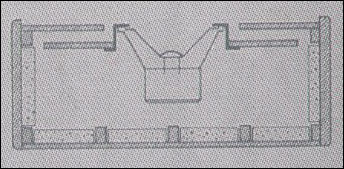
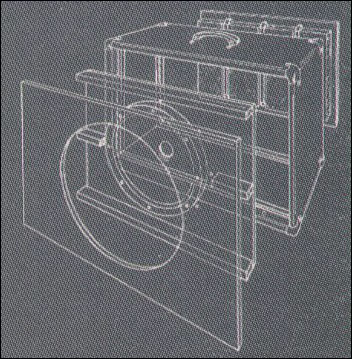
What kind of wood is used in your cabinets?
We use solid pine for the sides of our Fender style cabinets, and baltic birch ply for British style. Typically, baffles and backpanels are made of baltic birch or another void free ply.
Will Mojotone load my cabinet with speakers?
Want your Mojo cab loaded? Contact sales@mojotone.com for loaded cabinet pricing!
Capacitors FAQ
Do different types of capacitors have different sound qualities?
Changing the type and value of capacitor used in your guitar's wiring harness can have an effect on the overall sound of your guitar. We have compiled a list of sound characteristics for each different type of capacitor, but please remember that all changes to tone are subjective and each user could understandably derive different sound traits from any component change.
Ceramic Disc - Flat sounding, slightly harsh or edgy.
Foil Film (Mojotone Dijon) - Transparent and smooth. Our most popular cap for amps and guitars.
Oil Filled (Mojotone Vitamin T) - Slightly darker and smoother.
Metalized Film (Orange Drop) - Flat sounding with a little more warmth and transparency than ceramic disc.
In regards to cap values, this really depends on how much and how quickly you want the treble to roll off. The higher the value, the more treble will be rolled off.
Mojotone Dijon FAQ
We have received numerous inquiries on the Dijon caps as to what to expect from them so we decided to give out some info on how we came to carry them.
The original project was to either manufacture Mallory 150 style caps that looked like the original mustards used in early British amps, or to replicate the manufacturing of them in a standard looking package, or if we were really lucky both. The manufacturer we went with said they could replicate the build process but not the look, and that the reason more caps are not made this way is; part of the process requires human hands as part of the manufacturing. With that we had samples made.
Normally first run samples have issues that have to be worked out, this was not the case with the Dijons. We sent them to many OEMs and received rave reviews. We left it to them on the sound tests - but we did decide to cut a few caps open and have a look. The pictures show 3 .022 caps. A Sprague Orange drop, a Mallory 150, and a Mojotone Dijon. What may or may not be obvious from the pictures are the following observations.


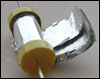
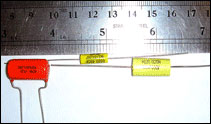
So with that said you may still be asking yourself "why try these caps?" Our only answer is "why not". They are not extremely expensive and if you like them as much as most people do, you will have another tone tool in your arsenal.
Which side of a capacitor is connected to the outside layer of foil?
Some people want to know which side of a capacitor is connected to the outside layer of foil, so they can connect it to the low impedance side of the circuit. In the case of Vitamin T capacitors, the outside layer is the case, which is visibly connected to one of the leads.
Unfortunately there is no way to determine which lead is connected to the outer layer of foil with our Dijon caps. In regards to the direction of the text, this should never indicate the direction of the leads as the cap may enter the printing device in any orientation, thus making the print inconsistent.
Why are you phasing out the Sprague Atom Caps?
Sprague Atom Capacitors are a historical product line which has served well for vintage amplifier reproduction and repair. During the past 10 years or so they were listed as "not suggested for new designs." According to Sprague, this is not because they intend to discontinue them at any time, but in any case, the price has doubled and we have decided to move on to other sources.
Our solution is to work with Tube Amp Doctor's capacitor line. As we run out of stock of each Atom type, it will be replaced by the comparable TAD capacitor. The physical size of the TADs will be smaller and the price will be somewhat less, but the operation will be the same. Since the spring of 2007 all TAD caps have weathered the changeover and all reports of replacement use have been satisfactory.
Chassis FAQ
Can I order a custom chassis from Mojotone?
The Mojotone design team has extensive experience with metalwork engineering, which allows us to design practically any custom chassis needed. Depending on the amount of work involved, engineering fees typically range from $60-$180.
If you are capable of providing detailed engineering drawings of a custom chassis, we can provide a quote, but we always suggest that minimum orders are at least 25 pieces, as anything less than 25 pieces becomes very expensive.
The best pricing is usually between 50 and 100 pieces, and 100 piece orders can be split into two releases 45 days apart.
Email sales@mojotone.com for a quote.
As an economical alternative to ordering a custom chassis run, Mojotone offers a blank (no holes) chassis that is much like the Mojotone British 45 and 18W style chassis. These are made from aluminum and are easy to punch and drill.
You can find them on our site here.
Control Plates FAQ
Can Mojotone make me a custom faceplate?
FOR THE CUSTOM AMP BUILDER
As a custom amp builder, you need the ability to integrate branding and custom features into your product line while maintaining a clean, professional design. Whether you specialize in putting your spin on a classic, or have designed something from the ground up, we can assist you with your custom engraving needs.
FOR REPRODUCTIONS
Need an old faceplate reproduced? As long as you can send the original for reference, we can return a beautiful reproduction.

A reproduction control panel using the black reverse engrave
WE ALSO OFFER OUR SERVICE FOR ALL OTHER GENERAL ENGRAVING ON PLASTIC
You can give a clean, professional look to almost any application. Below are just a few examples.
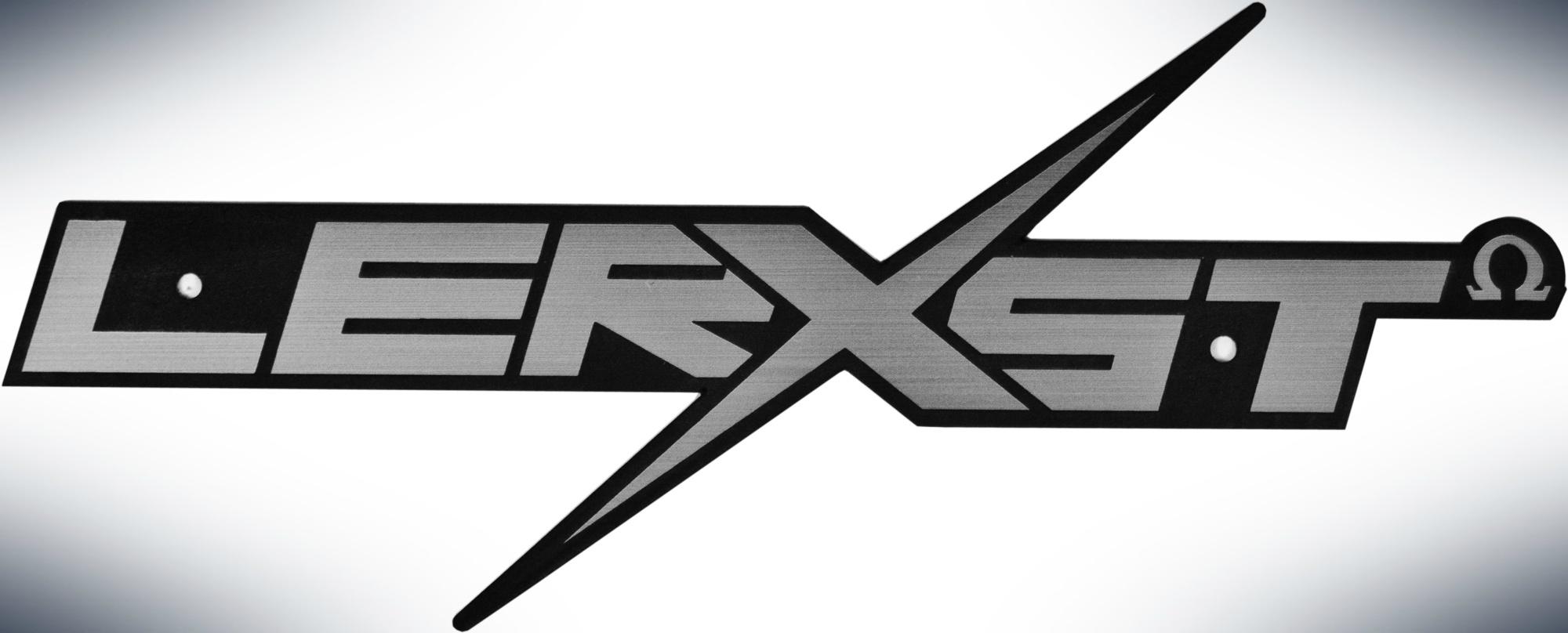
A logo using the brushed silver front engrave

A nameplate using the brushed gold front engrave
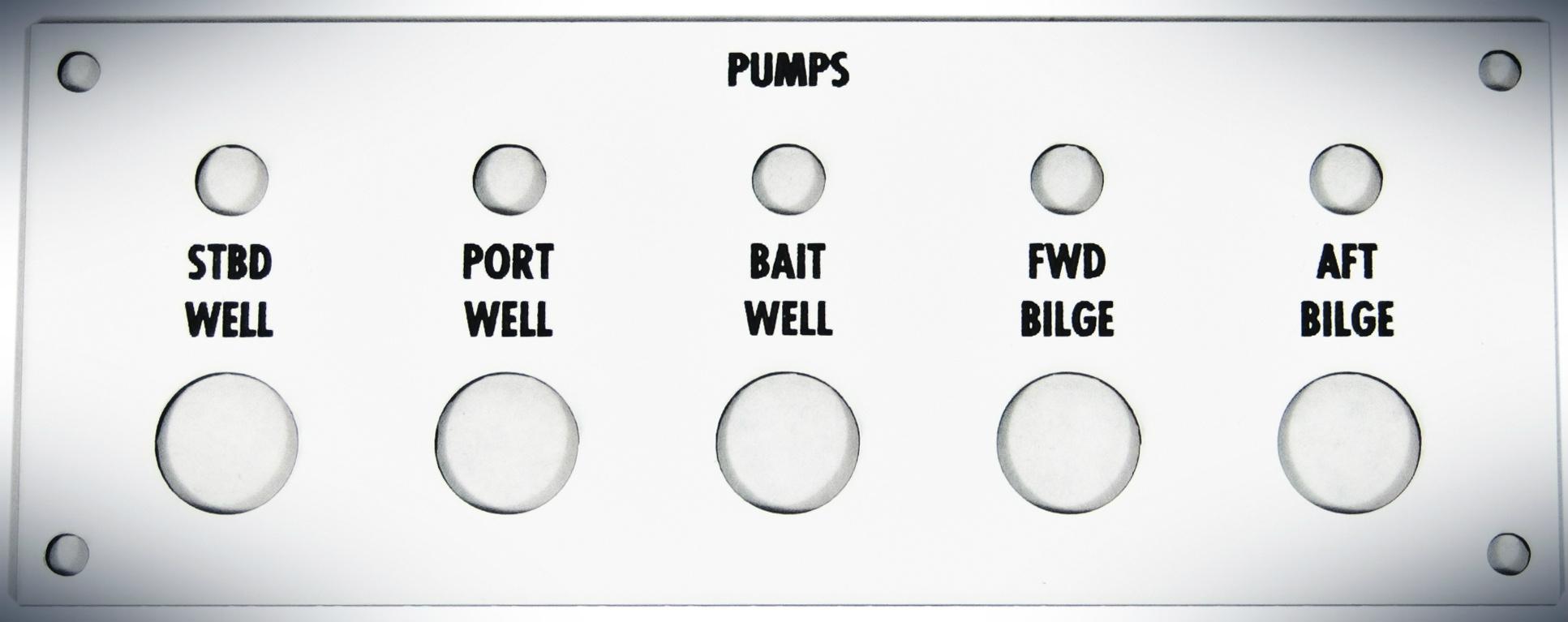
A toggle switch plate using the white front engrave
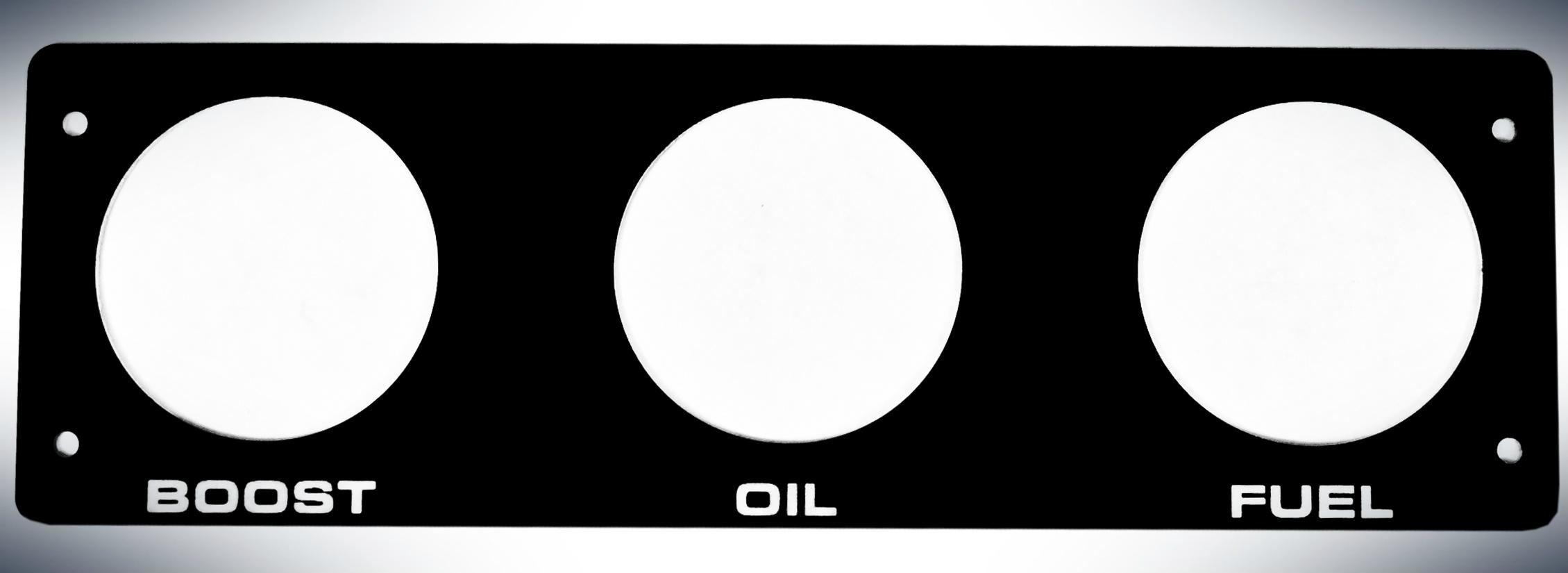
A gauge bezel using the gloss black front engrave
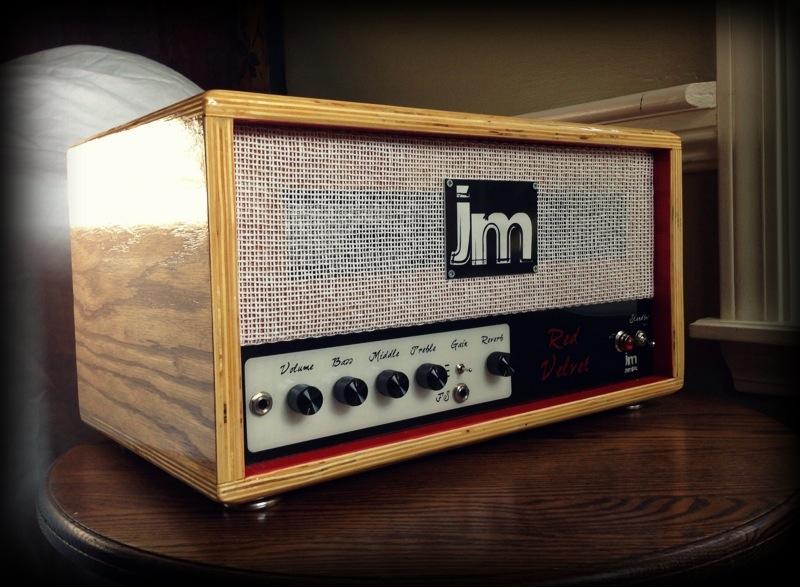
Red Velvet Amp
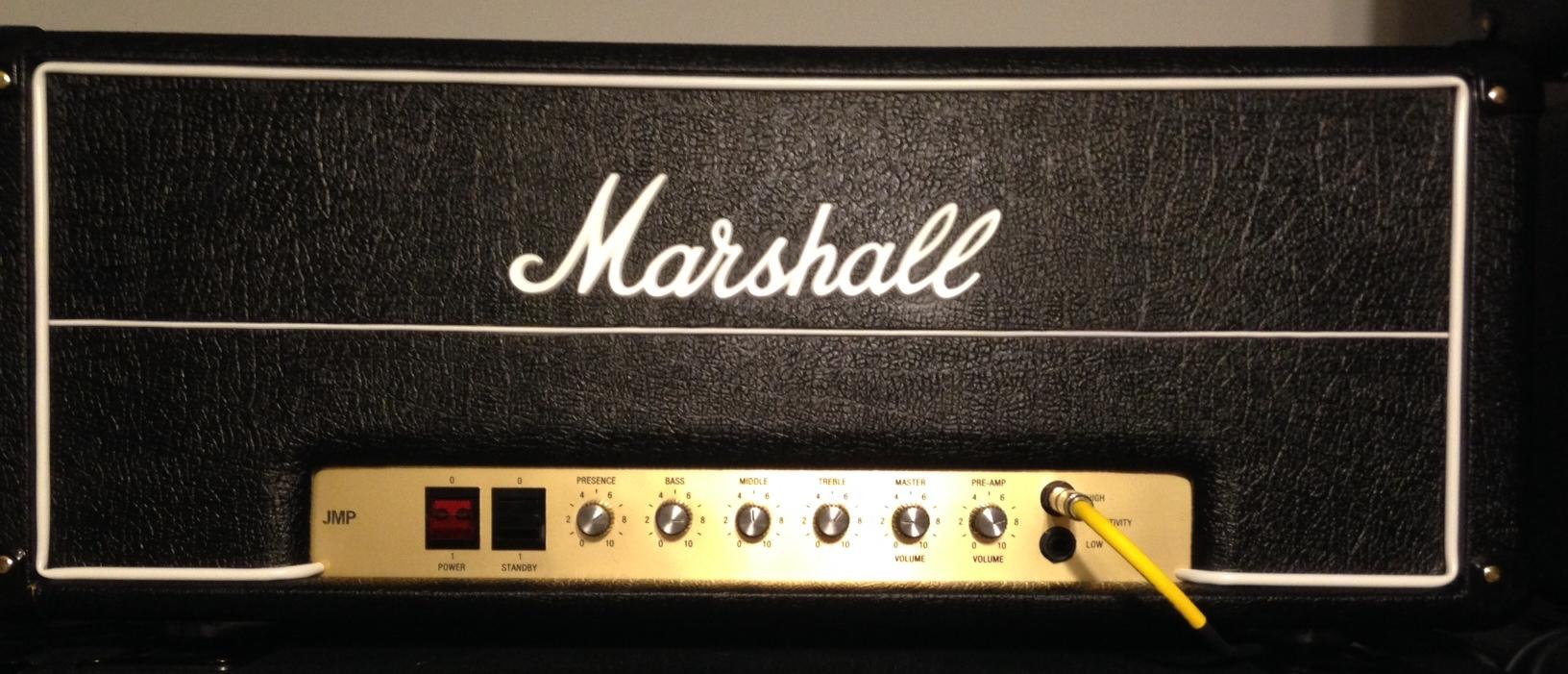
Marshall JMP reproduction plate belonging to Jim Black Jr.
How much does a custom faceplate cost?
PRICING
- Prices are based upon the size and complexity of the design.
- Price breaks are offered for larger quantity runs.
- A drawing with dimensional information is required.
- A setup fee is required for custom work.*
*This is a one-time per design fee that will be determined after the receipt of the drawing. Hand-drawn submissions will generally require a higher setup fee.
Email sales@mojotone.com to Get a Quote.
-or-
MAIL US A HAND-DRAWING OR ITEMS TO BE REPRODUCED.
Mojo Properties, LLC.
ATTN: David Butler
137 Worth Beverage Drive
Burgaw, NC 28425
U.S.A.
DRAWING REQUIREMENTS
Since quotes are based on size and complexity, a good starting point is knowing the hole layout and overall size of the piece. The best way to show this is with a drawing that includes measurements of distances between hole centers and the left side and bottom of the piece, hole diameters, and overall piece size. Take a look at the example below:
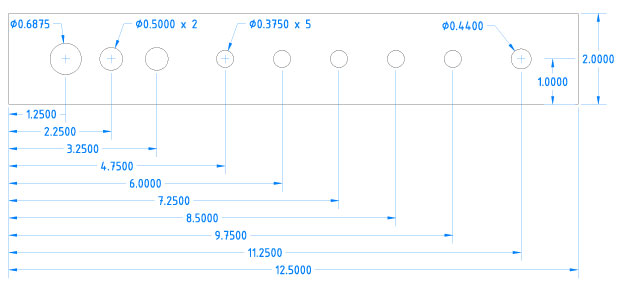
Accurate dimensional information is needed most. If you are good with a CAD program, and can provide the labeling and design information in an exploded format, then that's good because the setup fee will be less. Exploded format is one with all shapes including letter characters outlined.

Even better, if you can provide a 1:1 scale drawing in a .dwg or .dxf file format with all of the exploded design information, you will save most on the setup fee. If you don't want to deal with the tedium of laying out the actual design, that's ok, we can do it for you, just let us know what goes where. We'll send a proof in .pdf format that you will approve before the final piece is produced.
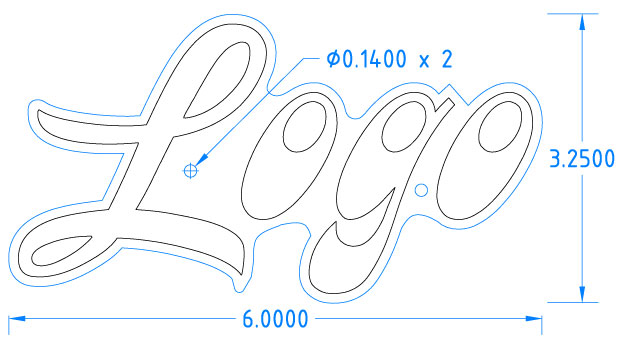
If you need a quote for a logo, we will need to know its overall size. Most importantly, we will need a drawing that includes vector line information, and if this is not possible, then the original file may work as long as it is not in a .jpg or .jpeg file format. Below is an example of what you may see in a proof of a logo:
What materials does Mojotone use to make custom faceplates?
REVERSE-ENGRAVE MATERIAL
The design will be engraved in reverse on the bottom or back side of the material. It will be visible in the correct orientation on the front. The engraving can be filled with black or white paint. The result is a smooth front with no engraving impression. All of our reverse-engrave material provides a gloss finish.
FRONT-ENGRAVE MATERIAL
The design will be engraved on the top or front side of the material. The process will leave an engraving impression on the front down into a sub-layer which dictates the design color. This type will yield better contrast between the design and background over the reverse-engrave material.
STYLES
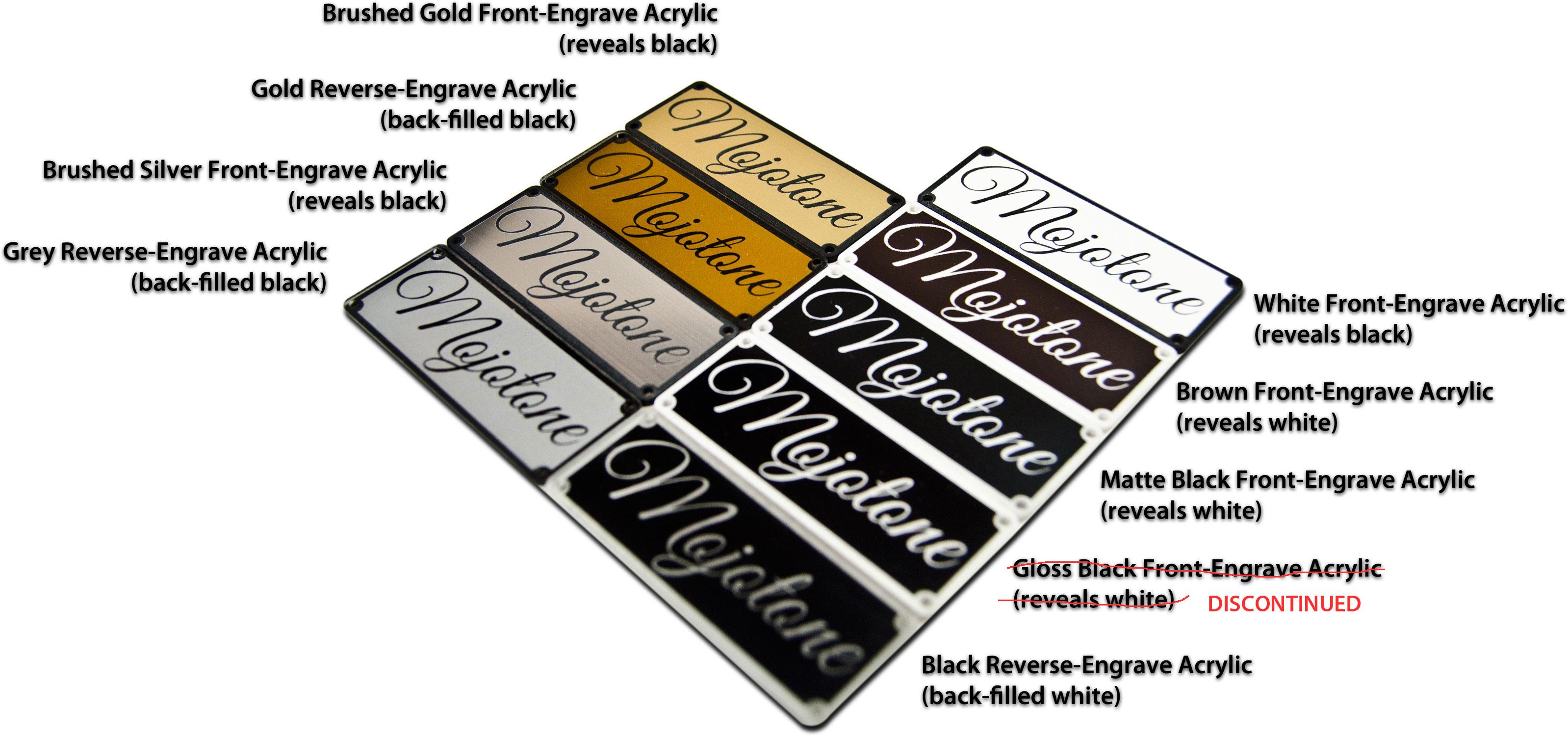
All of our engraving materials are 1/16" thick plastic.
Guitar Wiring Kits FAQ
Do I need a long shaft or short shaft pot?
This is a common question when it comes to Les Paul guitars, as they do use both depending on the model. We recommend measuring the threaded portion of the pot you have. If the threaded portion is 3/8" long, you need a short shaft potentiometer. If the threaded portion is 3/4" long you need a long shaft pot. If you are unsure, it would be best to choose a long shaft pot, as you can use an extra nut to adjust the length accordingly.
Logos FAQ
Can Mojotone make me a custom faceplate?
FOR THE CUSTOM AMP BUILDER
As a custom amp builder, you need the ability to integrate branding and custom features into your product line while maintaining a clean, professional design. Whether you specialize in putting your spin on a classic, or have designed something from the ground up, we can assist you with your custom engraving needs.
FOR REPRODUCTIONS
Need an old faceplate reproduced? As long as you can send the original for reference, we can return a beautiful reproduction.
A reproduction control panel using the black reverse engrave
WE ALSO OFFER OUR SERVICE FOR ALL OTHER GENERAL ENGRAVING ON PLASTIC
You can give a clean, professional look to almost any application. Below are just a few examples.
A logo using the brushed silver front engrave
A nameplate using the brushed gold front engrave
A toggle switch plate using the white front engrave
A gauge bezel using the gloss black front engrave
Red Velvet Amp
Marshall JMP reproduction plate belonging to Jim Black Jr.
What is the best way to install a logo?
The easiest way we've found for installing these is as follows:
1) Dip the logo pegs in paint or dab them with some white-out.
2) Press the logo onto the grill cloth so the paint leaves small dots
3) Drill holes where paint markings have been made-
Some customers put a dab of hot glue on the pegs prior to inserting them into the holes for a bit of extra security, but this is not always necessary.
Pickup Parts FAQ
Can Mojotone make custom flatwork for me?
In short, yes we do lots of custom flatwork for our customers. We are equipped with 4 large CNC lasers to handle the demand.
Here is some general pricing information:
- $60.00 setup fee per run
- $1.25 minimum per piece per run (This doesn't mean sets. It's per piece, 1 top piece and 1 bottom piece $1.25 each).
- 100 piece minimum
Setup fee is waived for order over 200 pieces.
DWG/DXF AutoCAD file(s) needed.
If you need us to draw the file for you, there is a $60.00/hr engineering fee.
Email sales@mojotone.com to Get a Quote
How many coils can I wind from a 1/2 pound of wire?
There is about .04 pound of wire per humbucker bobbin assuming 5500 turns are made, and about .07 per strat or Tele assuming 8000 turns are made. That being said, one should be able to get roughly twelve humbucker coils or seven single coils out of a 1/2lb spool.
What material is Mojotone's flatwork made out of?
We use Black Vulcanized Fiberboard (some call it Forbon) material. This is the same material that was used in the 50's, it is effective, non-conductive and screened for quality right here at Mojotone headquarters.
Pickups FAQ
Do covers affect the tone of a pickup?
The type of metal cover you choose can have a significant affect on the sound of your pickup. Generally metal covers will knock some of the highs off, making the pickup sound warmer or darker, while plastic covers will have no effect at all. It is generally found that the most magnetically transparent metal cover available is high quality nickel silver.
All of the metal covers available at Mojotone are made from pure nickel silver, with the only exception being the plating. The cover itself is nickel silver but the plating is ferromagnetic and will have a slight affect, as it acts as a very thin magnetic shield.
How can I become a Mojotone pickups dealer?
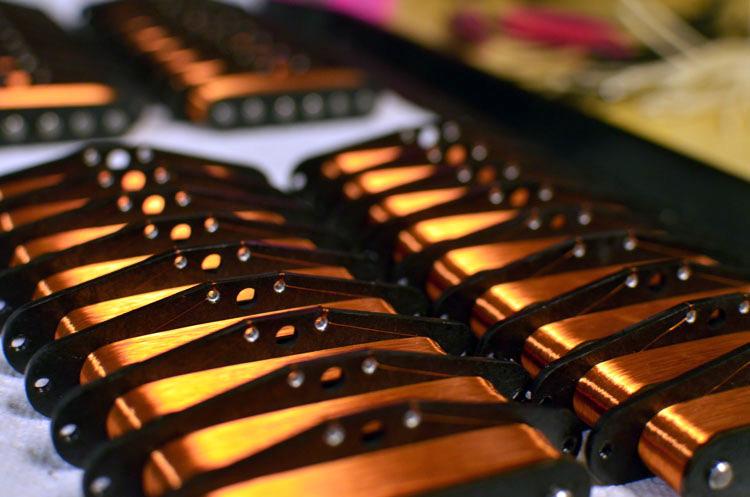
American made to last a lifetime...
Handcrafted in North Carolina with superior quality, detail, and tone.
Mojotone offers great pricing discounts for stores and builders and we are always welcoming new dealers and OEM's. For more information please contact us today HERE.
How do I adjust guitar pickup height?
Pickup height is a personal preference, however there are reasons for making certain adjustments. Below are standard measurements we use on a daily basis when setting up guitars. All are our own personal preference, so please feel encouraged to experiment...
All measurements are in 32nd's and 64th's of an inch and are taken from the top of the pickup pole and the bottom of the string (while pressing the string down against the last fret). The bass side represents the low E string and the treble side represents the high E string on a standard 6 string guitar. It would be the low E and high G for a standard 4 string bass.
Telecaster/Stratocaster/Jazzmaster/Jaguar/Mustang/Jazz Bass/P-Bass single coil pickups-
- Neck pickup: 4/32" treble and 5/32" bass side
- Bridge pickup: 4/32" treble and bass side
TIP: Be careful with Strats especially, the pickups set too close can pull the strings and create a multitude of problems (3 pickups = 3 magnets on one string!)
Humbucker/P-90 adjustable polepiece pickups-
- Neck pickup: 5/64" treble side and 3/32" bass side
- Bridge pickup: 2/32" treble and bass side
TIP: With adjustable poles, you can stagger them for the strings. Be careful setting the pickups too close for drop tunings and super heavy strings.
Keep in mind these are "general" specs, however they should yield excellent results and will act as a great starting point.
David Shepherd (Mojotone pickups and guitar parts manager)
I have questions about your Quiet Coil Strat Pickups...
What is the difference between the ‘58 and ‘67 Quiet Coils?
There is a significant tonal difference between the 67's and 58's. Just like the original 1958 and 1967 strat pickups, the materials, number of turns, winding patterns, etc all changed, which is why there is a tonal difference between the two. The 58's tend to sound brighter with more upper midrange presence, which gives them a more open and woody sounding tone, compared to the 67's which are more scooped on the mids and tend to have more quack and overall glassier highs. Think SRV or Clapton Brownie strat tones with the 58's, and think Hendrix or Gilmour strat tones with the 67's.
I see you recommend 500k pots for the Quiet Coils, but can I use 250k pots instead?
The Quiet Coils are designed to work with 500k pots because they utilize 2 coils and 2 magnets per string rather than 1 coil and 1 magnet per string like a single coil. That being said, you have to double the resistance of the pot to 500k to match the impedance for a true single coil tone. We also sell prewired assemblies and prewired pickguards specifically for the Quiet Coils which are equipped with 500k pots. The prewired pickguards are also completely solderless so you don’t need to worry about solder skills or professional installation.
None of the other hum-cancelling strat pickups seem to fit my guitar because they are too tall. Will your Mojotone Quiet Coils fit my reissue strat with the vintage pickup routs?
The Quiet Coil strat pickups are only about 1/16’’ taller than standard vintage strat pickups because of the shielding plate on the back of the pickup. That being said, as long as you lay the lead wires flat and side by side across the back of the pickups, without twisting or stacking the wires over top of one another, they will fit the shallow vintage routs just fine. We installed them into a ‘57 reissue here with no issues.
Why do I hear noise, especially when I remove my hands from the strings?
With any hum-cancelling pickups, if you hear noise or buzz, especially when you take your hands off of the strings, it is most likely not the fault of the pickups but quite possibly the lack of shielding in your guitar. The Quiet Coil pickups are designed to be “hum-cancelling” against single coil 60 cycle hum, but they are not shielded against RF or EMI noise. The reason we do not shield the pickups or wires themselves is because it adds capacitance directly to the circuit and changes the tone. It is recommended to completely shield the pickguard and control cavities, and connect the shielding to ground along with the ground wires from the tremolo/bridge and input jack. Shielding helps block out unwanted RF/EMI noise for the most quiet performance possible.
Can I get them made left handed?
Yes we can reverse the faux polepiece stagger for the look of left handed orientation by request. But the pickups themselves do not need to be made specifically for left handed guitars. See polepiece FAQ below.
Can I get the polepieces flat or change the stagger?
The short answer is no. The Quiet Coil polepieces do not serve any purpose other than looks. We carefully considered players who don’t like the feel of magnets under their hand by beveling the tops and keeping them lower or flush to the cover. The actual Alnico magnets are hidden below the cover and the magnetic field is solid across all of the strings so there is no need to stagger the magnets or worry about string spacing. They can also be installed for left or right handed guitars because the actual magnets themselves are not specifically oriented for left or right handed guitars.
Do standard Fender strat pickup covers fit?
Most standard American strat pickup covers will fit, however they are shorter so there will be a gap between the bottom of the pickup and the bottom of the cover. You won’t see this gap under the pickguard anyway. However many of the standard strat pickup covers can be too thick on the top leaving our polepieces below the cover so we recommend using our Quiet Coil covers instead which are thinner on the top. They also cover the entire coil so there is no gap. We can sell them by request for customers who own Quiet Coil strat pickups.
Can I coil tap them?
No we do not build the Quiet Coils with 4-conductor wire. These are designed to be like vintage strat pickups with 1 lead for ground and 1 lead for hot. There is really no reason to coil tap them anyway considering they already sound exactly like single coils. Coil tapping them would just make them sound thin and weak.
Do I need a treble bleed capacitor?
Yes we recommend using a 470pf - 500pf treble bleed cap in between the input and output of the volume pot. This will keep your treble clear when rolling the volume back so the pickups don't get muddy sounding. We do NOT recommend using a resistor in series or parallel with the capacitor as it can reduce the output of the pickups slightly. See our wiring diagram.
What are the recommended pickup heights?
We recommend starting at 3/32’’ on the treble side and 4/32’’ on the bass side. All measurements are taken while pressing the string against the last fret and measuring from the top of the polepiece to the bottom of the string. You can adjust the Quiet Coils closer without magnet pull on the strings so there is more room to adjust the pickups to your own personal preference.
Can I get them custom wound to my spec and change the magnet type?
At this time we are not offering custom versions of the Quiet Coil pickups. We put years of research and development into the current models and we believe they represent the best possible sound you can achieve from their current specs.
Mojotone Pickup Warranty and Exchange
Limited 1-Year Warranty
Unsurpassed customer service and premium quality is hard to find, which is why we stand behind our pickups with a limited 1-year warranty. If your pickup stops working under normal conditions, we will repair it or replace free of charge minus postage, to the original purchaser.
Exchange Policy
It is our mission to get the tone you are after, so we offer a 30-day exchange period (30 days from original delivery) for any of our standard pickup models. You are responsible for any greater difference in price, and all shipping costs to and from Mojotone. The pickups being exchanged must be in "new" condition with full leads intact. Custom and OEM pickups are not eligible for exchange.
Refund Policy
Given the small and custom nature of our business, we do not offer refunds for pickups or prewired assemblies.
Warranty Guidelines and Exclusions
The warranty does not apply to OEM manufacturers who install our pickups as original equipment. The warranty will be voided for any installation mishaps, misuse and abuse of any kind, modifications (such as removing soldered metal covers, removing tape, cutting leads, etc) or any acts of nature such as moisture or heat damage. The warranty also does not cover cosmetic wear and tear such as rust and pitting of the metal parts, or worn and oxidized plating of covers and screws.
To obtain warranty or exchange service, you must be the original purchaser and follow these steps.
- Contact our sales department for an RMA number.
- Call toll free 1-800-927-6656 or email sales@mojotone.com
- You must include your proof of purchase.
- Send pickup(s) to the following address below.
Mojotone
Attn: Pickup Dept.
137 Worth Beverage Dr.
Burgaw NC, 28425
What is F Spacing? Do I need 50mm, 53mm, or 49.2mm?
F-spacing refers to a wider string spacing at the bridge. This would be used for any Fender style guitar to provide for proper pole alignment underneath the strings. A typical F-spaced set would be 52mm or 53mm at the bridge and 50mm at the neck. If you do choose to use the 53mm, your ohm reading will increase but apparent output will not. The number of turns is the crucial factor and they do not change to compensate for the increased ohm reading.
What is RWRP (reverse winding reverse polarity)?
The RWRP designation in a single coil prevents hum when both pickups are engaged. Each pickup is a mirror image of the other with the electrical and magnetic polarities being opposite. This does not prevent hum when only one pickup is being used.
What is the right magnet and output for me?
Understanding some basic characteristics of guitar pickup components, such as magnet types and DC resistance, may help one narrow their search within the wide variety of pickups available. There are many other aspects that can help determine a pickup's overall sound, but the following information should help in making an informed decision.
Magnet Types
Alnico 2
Warmer sounding with less magnetic pull to allow the strings to vibrate more freely. A good choice for warming up a bright or harsh sounding amp and guitar. Overall the Alnico 2 is warm, with clear mids, spongier bass, and a softer attack. Many players use the Alnico 2's to better achieve the vintage tone heard in many pickups from the 50's era.
Alnico 3
Considered to be brighter than Alnico 2 with the least magnetic pull to allow the strings to vibrate more freely. A good choice for clean tones and lots of articulation. Overall the Alnico 3 is bright, with clear mids, warm bass, and a softer attack.
Alnico 4
This magnet is best described to have the characteristics of both Alnico 2 and Alnico 5. Kind of a happy medium.
Alnico 5
Bright sounding with more focus and enhanced dynamics. A good choice for adding a brighter punch to a warm or dull sounding amp or guitar. Overall the Alnico 5 is bright and punchy, with glassy highs, tight bass, and more attack. Alnico 5 magnets are the most commonly used magnets in guitar pickups today.
Ceramic
Considered to be the most aggressive sounding magnet. A good choice for adding bright punch and output to a warm or dull sounding amp or guitar. Overall the ceramic magnets are bright, with clear upper midrange, compressed highs, very harmonic, tighter bass, and aggressive attack. Ceramic magnets are most commonly associated with higher output or higher DC resistance pickups.
Notes on output
For the most part (not always), DC resistance can give you a basic idea about the overall output and response a pickup will give you. Generally the more winds you put on a coil, the higher the DC resistance. Increasing the DC resistance with the number of winds will increase output, but will also increase lows and mids while reducing the amount of highs. This can be good or bad depending on what you are looking for. Don't become too focused on the reading as it is only one part of the equation. These readings can fluctuate due to temperature, wire diameter variations, and other factors. Don't assume that a "lower output" will have less because of it's reading. You must compare the same type of pickup for this to work. In other words, don't think a 7.7k strat and 7.7k humbucker will be equal. The coil length, shape, and wire size will all play a part in the final result.
Why choose Mojotone pickups?
Passion, experience and some really good ears...
Much more goes into making our pickups than just magnets and wire. Our focus is making extremely high quality pickups that not only sound absolutely amazing, but are designed and built with unsurpassed attention to detail and quality. We do this by spending obsessive amounts of time with our products, whether it's endlessly designing prototypes to get the sound "just right", or making sure that each pickup is built consistently from one to the next. It's about passion combined with experience and some really good ears when it comes to making Mojotone pickups sound so good.
It's all about the details and materials...
Absolutely no details, costs, or corners are cut with our pickups. Not only do we design amazing new pickups, we also recreate authentic clones of original vintage pickup designs. Most pickup makers just build them to sound like a vintage pickup, but they don't use vintage correct parts or manufacturing methods. Sure, these small details may not have much effect in regards to actual sound, but they have everything to do with being authentic and vintage correct, which we think is exactly the point. If the original pickup was handwound, we handwind it too. If the original vintage pickup used nickel silver alloy, or butyrate plastic bobbins, we made sure ours did too. We build everything with extreme attention to detail, with no sloppy or inconsistent pickups. We aren't building rockets, but we sure build pickups to that same level of detail that speak for themselves once you lay eyes and ears on them.
When in doubt just listen...
Mojotone pickup winders always have a keen sense of ability to not only listen to the pickups themselves but also to what the guitar player wants. This plays a major role in how well our pickups exceed expectations. Just copying other pickups or relying on our meters and graphs to determine the sound doesn't make great sounding pickups. Using our ears and listening for what the player wants (or doesn't want) and knowing exactly how to achieve it consistently is what helps us create great sounding pickups. Not only do Mojotone pickups ooze with good tone, we believe that if you If you listen close enough you can hear the passion, research and all of the hard work that goes into each and every one. Otherwise we wouldn't even consider offering them to the world!
Potentiometers FAQ
How do I install a no load tone control in my guitar?
No special wiring is required for the No Load pot to work. You may refer to any standard Tele wiring diagram for instructions.
What does the KA, KB, and KC label mean on your pots?
These letters refer to the actual taper of the pot. The K only has to do with the ohms. For example 500K ohms. The following letters A, B, and C refer to the actual taper.
- A = Audio Taper
- B = Linear taper
- C = Reverse audio
You will normally only see the A, B, or C letters on metric pots, whereas US spec pots (such as CTS), will use a more straightforward lettering system such as A for Audio taper, L for Linear, and RA for reverse audio.
What is the difference between the split shaft and the solid shaft?
There is no difference in the functionality of these pots, but rather there is only a difference in what type of knob is used in conjunction with each pot. Solid shaft pots require a set-screw knob while the split shaft requires a push-on knob.
What value potentiometer should I use for my pickups?
It is recommended that 250k pots be used for single coil pickups, as single coils tend to be very bright sounding inherently. For humbuckers, it is recommended that 500k value pots are used, as humbuckers are naturally darker sounding. Higher value pots = more treble.
Reverb FAQ
How do I know which reverb tank I need?
The best way to find out what reverb tank fits your amp, is to locate the manufacturer number stamped on the top or side. This may require you to remove the tank.
Locate the 7-digit alphanumeric code on your tank; e.g., 4AB3C1B. Once you have this code, simply browse our reverb tank selection until you find a match.
What do the alphanumeric reverb tank names mean?
DIGIT #1 - REVERB TYPE
- 8 = short tank, three springs
- 4 = long tank, two springs
- 9 = long tank, three springs
DIGIT #2 - INPUT IMPEDANCE
- A = 8 Ohm
- B = 150 Ohm
- C = 200 Ohm
- D = 250 Ohm
- E = 600 Ohm
- F = 1475 Ohm
DIGIT #3 - OUTPUT IMPEDANCE
- A = 500 Ohm
- B = 2250 Ohm
- C = 10000 Ohm
DIGIT #4 - DECAY TIME
- 1 = Short (1.2 to 2.0 sec)
- 2 = Medium (1.75 to 3.0 sec)
- 3 = Long (2.75 to 4.0 sec)
DIGIT #5 - CONNECTORS
- A = Input Grounded / Output Grounded
- B = Input Grounded / Output Insulated
- C = Input Insulated / Output Grounded
- D = Input Insulated / Output Insulated
- E = No Outer Channel
DIGIT #6 - LOCKING DEVICES
- 1 = No Lock
DIGIT #7 - MOUNTING PLANE
- A = Horizontal Open Side Up
- B = Horizontal Open Side Down
- C = Vertical Connectors Up
- D = Vertical Connectors Down
- E = On End Input Up
- F = On End Output Up
Schematics FAQ
335 Three Way Wiring Diagram

72 Telecaster Deluxe Wiring Diagram

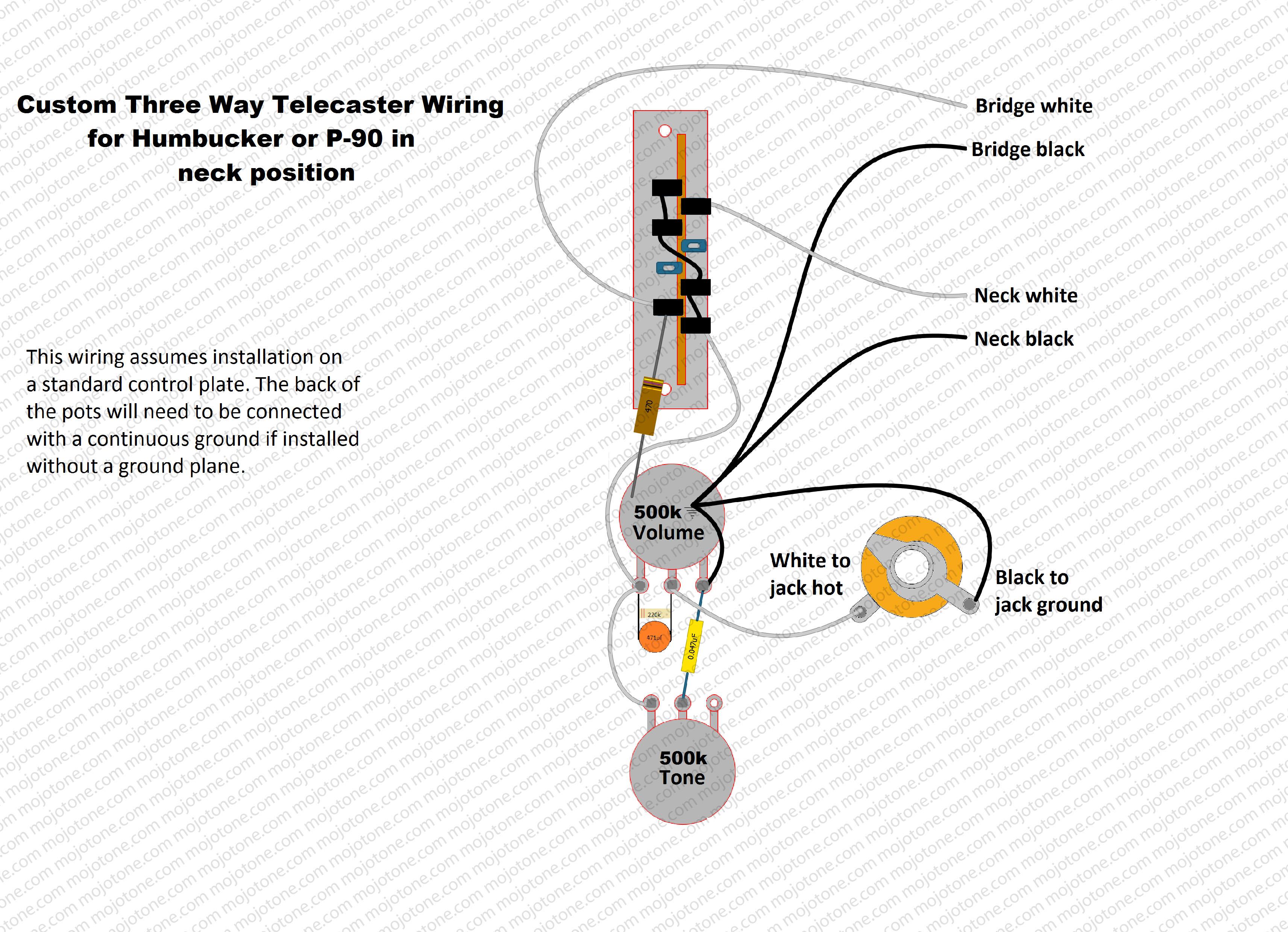
Custom Tele Three Way
Humbucker-Single-Single-With Dual Volume Control

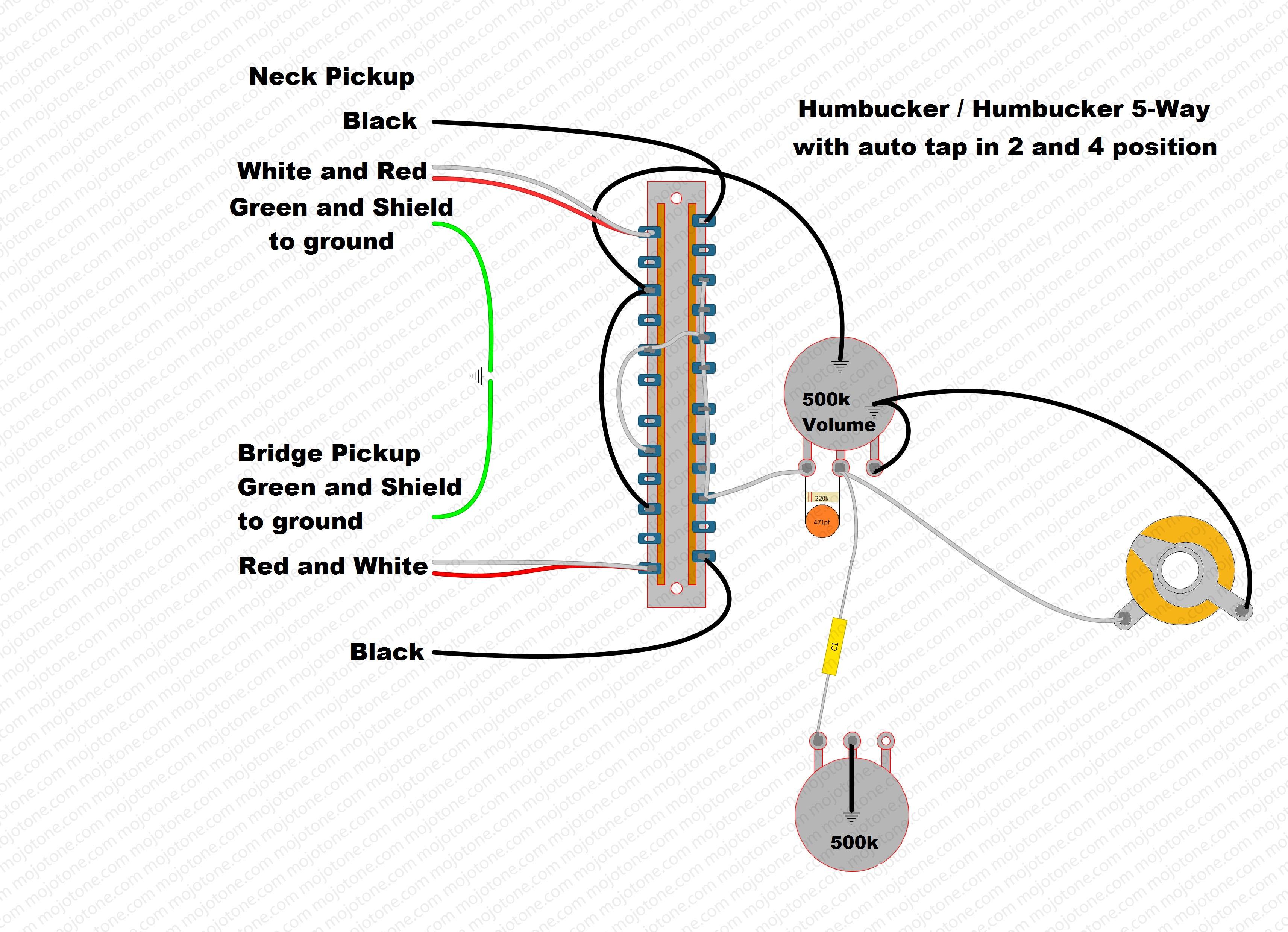
Humbucker/Single/Humbucker 5-way

Jazz Bass Wiring Diagram

Les Paul 3-Way Switch Wiring Diagram

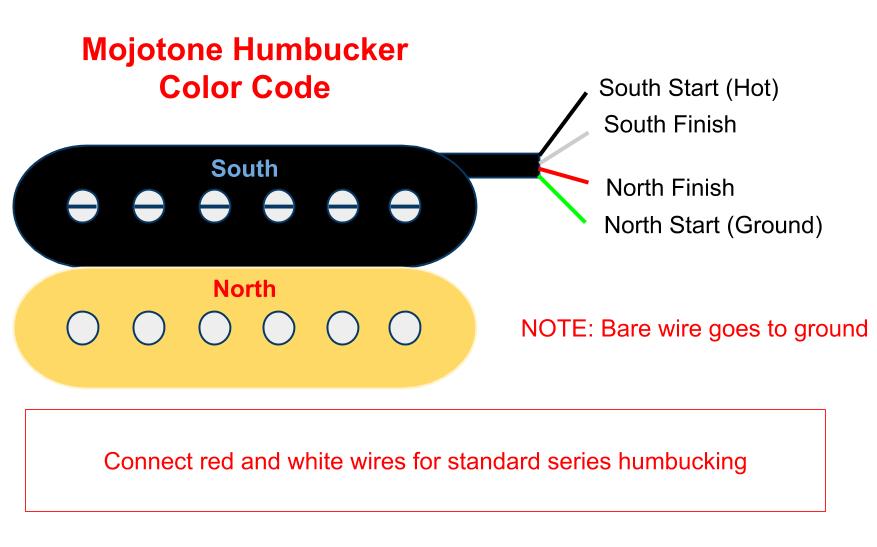
Mojotone Humbucker Color Code
P-bass wiring diagram

PRS Wiring Diagram

Stratocaster Blender Wiring Diagram

Stratocaster Convertible Wiring Diagram

Stratocaster HSS 5-Way Wiring Diagram

Stratocaster Standard Five Way Wiring

Telecaster 3-Way Convertible Wiring Diagram

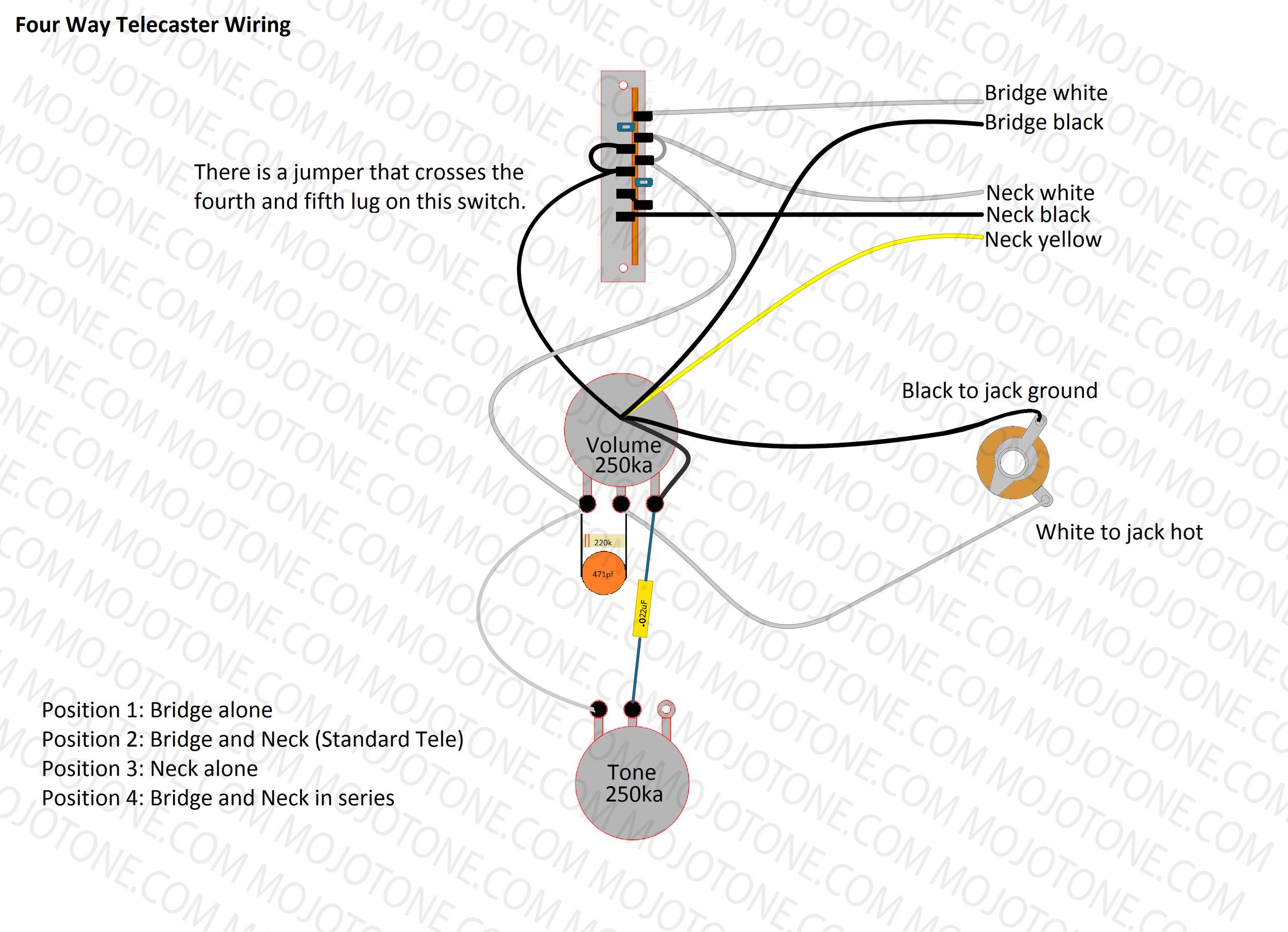
Telecaster Four Way Wiring Diagram
Telecaster Nashville Wiring Diagram

Telecaster Three Way Wiring

humbuckerhumbucker5way
Speakers FAQ
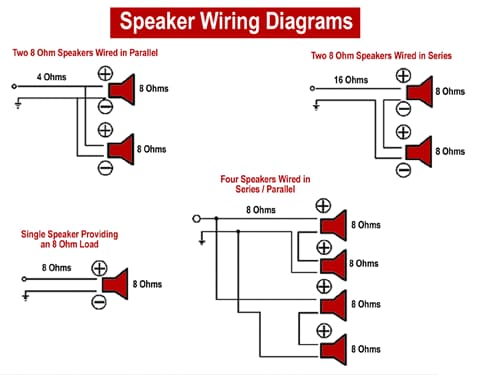
Speaker Wiring Diagram
Can I mix and match speakers in my cabinet?
Using different speakers in a single cabinet is totally fine as long as the impedance of both speakers match and they are wired to the correct impedance for your amp. Many people use different combinations of speakers in order to mix the qualities of each speaker.
How many watts should my speaker be and how will this affect my sound?
In a nut shell, a speaker with a higher power rating will be "cleaner" than one with a lower rating. This is to say that there will be less "speaker distortion" in the higher powered speaker. When we're talking about distortion in amps, obviously there are a number of factors which come into play; e.g. power tube distortion, preamp tube distortion, and speaker distortion. With a higher wattage speaker displaying less speaker distortion, one will hear more of the power and preamp tube breakup. With that said, there are also many other factors that make up the overall "tone quality" of a speaker, eg. voice coil size, paper type, efficiency, etc. All of these things can have as much or more effect on tone than just the power rating alone.
There is also the concept of how a particular speaker interacts with your amp and your specific playing style. Given that there are so many deciding factors, it is always best to try out as many speakers as you possibly can. This way you will be able to determine which kinds of breakup you prefer and which speakers pair best with your amp, guitar, and playing style.
I have some old Mojotone speakers that you no longer sell, what are they?
Mojotone introduced a line of speakers back in the 1990's that showcased the perfect marriage of versatility and affordable performance; below is a list of those speakers. If you want the same quality and value today, try one of our current production Mojotone speakers.
- Mojotone Black Beauty BB10G
10", 20oz. Ceramic magnet, 70 cnt watts/140 pk watts, 8 or 16 ohm, 97db eff., 1 1/2" Kapton voice coil - Mojotone Black Beauty BB12G
12", 46oz. Ceramic magnet, 100 cnt watts/200 pk watts, 8 or 16 ohm, 101db eff., 2" Kapton voice coil - Mojotone 8" M815
1" voice coil, 15 watt, 15 oz. magnet, 4 ohm - Mojotone 10" Alnico MP10R
1" paper voice coil, 30 watt, 6 oz magnet, 8 & 16 ohm - Mojotone 10" MP10RHD
1" kapton voice coil, 40 watt, 6 oz magnet, 8 ohm - Mojotone 10" M10VT32
2 " voice coil, 100 watt, 30 oz magnet, 32 ohm - Mojotone 10" M10RR
1.5" voice coil, 50 watt, 20 oz magnet, 8 & 16 ohm - Mojotone 12" Alnico MP12R
1" paper voice coil, 20 watt, 8 ohm - Mojotone 12" Alnico MP12RHD
1" kapton voice coil, 30 watt, 8 ohm - Mojotone 12" M121660
2" voice coil, 60 watt, 20 oz magnet, 8 ohm - Mojotone 12" M12B
1.375" voice coil, 80 watt, 38 oz magnet, 8 & 16 ohm - Mojotone 12" M12V30
1.5" voice coil, 50 watt, 30 oz magnet, 8 & 16 ohm - Mojotone 15" MJ15B Bass
2" voice coil, 100 watt, 38 oz magnet, 8 ohm - Mojotone 15" MJ15G Guitar
2.5" voice coil, 150 watt, 56 oz magnet, 8 ohm
What is Impedance?
In electrical engineering, impedance measures how easily a circuit conducts current when a voltage runs through it. Measured in Ohms, impedance is a way of telling you how much of the voltage introduced at one end will really make it to the other end. Impedance depends on other qualities of electricity, such as resistance, reactance, inductance, and capacitance.
The simplest kind of impedance happens with direct current, or DC, electricity. In this case, it's the same thing as resistance. All that gets in the way of electrons making it through the circuit is the circuit's resistance to the flow of current. Resistance usually takes the form of leaked energy that gets diverted from its intended pathway and creates extra heat.
With alternating current, or AC, impedance is much more complicated. The best way to understand how this characteristic works is to use an extended metaphor of freeway traffic. The whole point of a good freeway system is to transport people in vehicles, the way that a circuit carries electrons. The system might become less efficient if there are fewer people on the freeway, too many people, or too few lanes. There could even be bumps or obstacles in the road that cause cars to slow down, or lanes that accidentally route traffic away from its destination. Electrons face similar impediments.
Impedance is determined by resistance and another value, reactance. Reactance takes into account opposing forces and frequency; in other words, cars headed in the other direction and how many cars move past the same point at one time. Of course, more people will get to their destination if there are more net cars moving in one direction past a certain point, analogous to the effect frequency has on electron's energy. Two elements of reactance, inductance and capacitance, correspond to frequency. Inductance is in proportion to frequency while capacitance is inversely proportional to frequency.
Here at Mojo, in regards to amps, we use the Impedance rating on different items we sell, such as a pickup’s impedance (which is AC voltage), power and output amp transformer, and of course speakers. Here is a simple explanation of the transformer impedance:
Generally, there are 2 “sides” to the transformers we sell, known as the primary side, which handles the “input” or the line voltage to be transformed in the transformer. The other is the secondary, which has the voltage that is transformed to be fed, via different coils, to different parts of the amp.
Please note that with the transformers we sell, the “transformation”, in a power transformer, is taking the 120V from the wall basically a low voltage- high current supply and making a high voltage low-current supply to feed various voltages throughout the amp. With output transformers, it does the exact opposite. It takes a high voltage low-current DC voltage via rectification (usually known as B+), and makes a low voltage -high current feed for the speaker to translate what the amp has amplified.
Now, that being said, the impedances that relate to the output transformer primaries and secondary’s has to do with what is feeding the transformer (tubes) and what the transformer feeds (speaker). If you notice, different amps use different tubes, and those tubes have different power and signal input requirements, e.g. plate resistance, for the type of amp you have such as cathode biased Tweeds and Vox, fixed biased Blackface and Marshalls, Ultra-linear Silverfaces, etc. and the multitude of different tubes you can use for the amp.
One last word…. About speaker impedance….. people generally relate the impedance and resistance of the speaker voice coil as to what the meter tells them. Everyone has noticed that an 8 ohm speaker is actually 6.6~6.8 ohms, which is the actual resistance, not impedance of the voice coil. Most speaker companies rate speakers by Nominal impedance, not resistance. Which is, again, is the total of the resistance, plus reactance, capacitance, and inductance.
See sample of a Celestion G12M below, noting the resistance vs. impedance.
- Chassis type-Pressed steel
- DC resistance, Re- Available 6.7Ω or 13.1Ω
- Frequency range- 75-5000Hz
- Magnet type- Ceramic
- Magnet weight- 35oz, 0.99kg
- Nominal diameter- 12", 305mm
- Nominal impedance- Available 8Ω or 16Ω
- Power rating 25Wrms
- Resonance frequency, Fs- 75Hz
- Sensitivity- 98dB
- Voice coil diameter- 1.75", 44.5mm
- Voice coil material- Round copper
What's the difference between Mojotone BV speakers and Goldtone Celestions?
The idea for the BV series came when Celestion moved much of their operations to the far east and began sourcing what we considered critical parts there as well. To our surprise, the Asian-produced Celestion's have turned out to be excellent speakers but we often hear complaints of customers having cone cry issues. We sourced the original soft parts (cone, spider, dust cover) from the correct British manufacturer and then had our own baskets and magnet assemblies tooled in the US. The result is an American-made speaker with a British sound that is unmistakable.
We did a lot of testing with some very demanding players and amp builders - mostly the kind who like their British stacks and Gibson Les Paul's. We weren't done until they were certain the tone was as good, if not better than their vintage equipment and the incidence of cone cry was substantially reduced. Since Mojotone introduced the BV series, every other speaker manufacture has attempted to do the same thing - including the most obvious one! Those who have had a chance to try them, all agree the BV series stands out.
Switches & Jacks FAQ
What is the difference between a "switching" jack and a "shorting" jack?
People use "switching" and "shorting" interchangeably to describe jacks such as the J12A and the J1.
Why is there solder on my brand new Switchcraft switch?
All Switchcraft brand toggle switches are pre-tinned with solder from the factory. Don't worry, we would never sell you a used part unless specified.
Tolex & Tweed FAQ
How do I use Mojotone Tolex Glue?
Mojotone Tolex Glue will need to be applied to both the wood surface and the backside of the tolex itself. Once applied, let the glue sit for 1 hour. In this time period, the glue should transition from feeling thin and watery to feeling tacky and moldable; once this change occurs, the glue will be ready to use.
If adjustments are needed within the first 24 hours after application, a heat gun can be used to loosen the glue. You may then reposition your tolex as needed without applying any additional glue.
How much adhesive do I need for tolex?
If using Mojotone brand tolex glue, you will need roughly 1 quart of glue for every two yards of tolex you are working with.
How much tolex do I need to recover my cabinet?
Most small combos can be covered with one yard (36" x 54") of tolex. A Twin Reverb sized combo will take two yards, and if you are recovering a 4x12 cabinet, you will need four yards.
Vacuum Tubes FAQ
How do I know when I should change my output tubes?
There is a lot of information floating around on the net, some good, some bad. At Mojotone, we are not in the business of telling you to change out your tubes for one reason or another. However, you should be aware of some common signs that it might be time to change tubes...
- Output is weak or severely unbalanced
This one is tricky because, in older amps, it can also be due to the output transformer. But, if only due to complexity, the tube change makes sense as a first step. - Tubes show signs of overheating/darkening of the glass
This can also be a sign of OT damage or decay or overbiasing. With any output tube change the bias needs to be checked but with this one it is especially important. - Arcing over
Make sure and check the tube sockets and screen grid resistors if this happens. Usually accompanied by B+ or mains fuse failure. - Bad tone
This one is highly subjective and if your output is not lowered it is likely that your tone issues lie elsewhere - the preamp tubes may make more sense in this case. - Looking for a different sound
Again, pre-amp tubes are probably a better choice for this but if you have some experience and have heard a lot of tubes, the output section can be a place to tweak your amp. - Cracked glass
No choice here. Pony up and get the best replacements you can!
Things that do not directly indicate time for an output tube change:
- Blue light in the tubes that pulses with your playing
When tubes are flashed, the residual impurities in the vacuum are more or less removed. The less perfect the vacuum, the more blue pulsing you will see. By itself, this indicates almost nothing. - Dirty tubes
Wait until they are cool and clean them. Your amp will run cooler and love you for it. - Humming, noise, hiss, etc
None of these directly indicate power tube failure. If you don't know for sure and your tubes are relatively new anyway (say 1 or 2 years of moderate playing) then taking the amp to a tech may be less expensive in the long run. Hum, for instance, could come from out of balance on the output section. But that could be coming from a problem with biasing or the OT or it might have nothing to do with the output section and might be a crossed heater wire in the preamp or an unbalanced hum rejection circuit for the heaters, failing filter caps or any other number of things.
What are some common bias specs for tube amps?
Fender Amps
- (Most Fender 6V6 Amps) Nominal Output 20-30 watts - 18-30ma
- (Fender 5E3 Tweed Deluxe or equivalent) Nominal Output 15-20 watts - 35-50ma
- (Fender Tweed 6l6 Amps) Nominal Output 40-80 watts - 45-80ma
- (Fender Black Face style 6l6 Amps) Nominal Output 50 Watts - 25-40ma
Marshall® Amps
- Marshall® 50 Watt Amp (EL34's) - 25-42ma
- Marshall® JTM45 (KT66's) - 30-40ma
- Marshall® 100 Watt (EL34's) - 25-40ma
- Marshall® EL84 amps - 20-30ma
Privacy Policy
This privacy policy has been compiled to better serve those who are concerned with how their 'Personally identifiable information' (PII) is being used online. PII, as used in US privacy law and information security, is information that can be used on its own or with other information to identify, contact, or locate a single person, or to identify an individual in context. Please read our privacy policy carefully to get a clear understanding of how we collect, use, protect or otherwise handle your Personally Identifiable Information in accordance with our website.
What personal information do we collect from the people that visit our blog, website or app?
When ordering or registering on our site, as appropriate, you may be asked to enter your name, email address or other details to help you with your experience.
When do we collect information?
We collect information from you when you register on our site, place an order, subscribe to a newsletter, respond to a survey, fill out a form or enter information on our site.
How do we use your information?
We may use the information we collect from you when you register, make a purchase, sign up for our newsletter, respond to a survey or marketing communication, surf the website, or use certain other site features in the following ways:
- To personalize user's experience and to allow us to deliver the type of content and product offerings in which you are most interested.
- To improve our website in order to better serve you.
- To allow us to better service you in responding to your customer service requests.
- To administer a contest, promotion, survey or other site feature.
- To quickly process your transactions.
- To send periodic emails regarding your order or other products and services.
How do we protect visitor information?
Our website is scanned on a regular basis for security holes and known vulnerabilities in order to make your visit to our site as safe as possible.
We use regular Malware Scanning.
Your personal information is contained behind secured networks and is only accessible by a limited number of persons who have special access rights to such systems, and are required to keep the information confidential. In addition, all sensitive/credit information you supply is encrypted via Secure Socket Layer (SSL) technology.
We implement a variety of security measures when a user places an order to maintain the safety of your personal information.
For your convenience we may store your credit card information kept for more than 60 days in order to expedite future orders, and to automate the billing process.
Do we use 'cookies'?
Yes. Cookies are small files that a site or its service provider transfers to your computer's hard drive through your Web browser (if you allow) that enables the site's or service provider's systems to recognize your browser and capture and remember certain information. For instance, we use cookies to help us remember and process the items in your shopping cart. They are also used to help us understand your preferences based on previous or current site activity, which enables us to provide you with improved services. We also use cookies to help us compile aggregate data about site traffic and site interaction so that we can offer better site experiences and tools in the future.
We use cookies to:
- Help remember and process the items in the shopping cart.
- Understand and save user's preferences for future visits.
You can choose to have your computer warn you each time a cookie is being sent, or you can choose to turn off all cookies. You do this through your browser (like Internet Explorer) settings. Each browser is a little different, so look at your browser's Help menu to learn the correct way to modify your cookies.
If users disable cookies in their browser:
If you disable cookies off, some features will be disabled It will turn off some of the features that make your site experience more efficient and some of our services will not function properly.
However, you can still place orders.
Third-Party Disclosure
We do not sell, trade, or otherwise transfer to outside parties your personally identifiable information.
Third-party links
Occasionally, at our discretion, we may include or offer third-party products or services on our website. These third-party sites have separate and independent privacy policies. We therefore have no responsibility or liability for the content and activities of these linked sites. Nonetheless, we seek to protect the integrity of our site and welcome any feedback about these sites.
COPPA (Children Online Privacy Protection Act)
When it comes to the collection of personal information from children under 13, the Children's Online Privacy Protection Act (COPPA) puts parents in control. The Federal Trade Commission, the nation's consumer protection agency, enforces the COPPA Rule, which spells out what operators of websites and online services must do to protect children's privacy and safety online.
We do not specifically market to children under 13.
CAN SPAM Act
The CAN-SPAM Act is a law that sets the rules for commercial email, establishes requirements for commercial messages, gives recipients the right to have emails stopped from being sent to them, and spells out tough penalties for violations.
To be in accordance with CANSPAM we agree to the following:
If at any time you would like to unsubscribe from receiving future emails, you can email us at info@mojotone.com and we will promptly remove you from ALL correspondence.
Contacting Us
If there are any questions regarding this privacy policy you may contact us using the information below.
www.mojotone.com
137 Worth Beverage Dr
Burgaw, North Carolina 28425 USA
info@mojotone.com
800-927-6656
Last Edited on 2016-02-08